
Density Estimation with rbbnp
density-estimation.RmdThis article is a guide to kernel density estimation with
bias_bound_density().
Estimating a density
bias_bound_density() takes a data vector and returns a
density estimate with bias-aware pointwise confidence intervals:
bias_bound_density(
  x,                    # Data vector
  eval = NULL,          # Evaluation points (automatic if NULL)
  bw = "cv",            # Positive number, "cv", or "silverman"
  conf_level = 0.95,
  kernel = "schennach",
  control = NULL        # Named list of advanced settings
)
A basic fit, on data drawn from the 2-fold uniform distribution:
# Generate data from the two-fold-uniform distribution
set.seed(42)
x_data <- runif(1000) + runif(1000)

# Estimate density
fit <- bias_bound_density(x_data, bw = 0.08, kernel = "schennach")

# Display results
fit
#> Bias-Bounded Density Estimation
#>
#> Call:
#> bias_bound_density(x = x_data, bw = 0.08, kernel = "schennach")
#>
#> Sample size: n = 1000
#> Bandwidth:   h = 0.0800 (user-specified)
#> Kernel:      Schennach2004
#>
#> Bias bound parameters:
#>   A = 12.5357, r = 3.0000
#>   bias bound b1x = 0.0139
#>
#> Evaluation points: 100 (range: [-0.1746, 2.1780])
#> Confidence level: 95%
#>
#> Use summary() for detailed statistics
#> Use plot() to visualize results
The result is an S3 object of class bbnp_density. Use
coef() for the key parameters and summary()
for a fuller report:
# Key parameters
coef(fit)
#>        A        r        h
#> 12.53574  3.00000  0.08000

# Detailed summary
summary(fit)
#> Summary: Bias-Bounded Density Estimation
#> ============================================================
#>
#> Call:
#> bias_bound_density(x = x_data, bw = 0.08, kernel = "schennach")
#>
#> Sample Information:
#>   Sample size (n):  1000
#>   Bandwidth (h):    0.0800
#>   Kernel function:  Schennach2004
#>
#> Bias Bound Parameters:
#>   A (amplitude):    12.5357
#>   r (decay rate):   3.0000
#>   b1x (bias bound): 0.0139
#>   Xi interval:      [2.4074, 4.5544]
#>
#> Range Estimation:
#>   Density estimates:
#>    min Q1.25% median   mean Q3.75%    max
#> 0.0000 0.1111 0.4273 0.4217 0.7125 0.8798
#>
#>   Standard errors:
#>    min   mean    max
#> 0.0000 0.0341 0.0563
Visualizing the fit
The default plot shows the estimate together with the bias band and the confidence interval:
plot(fit)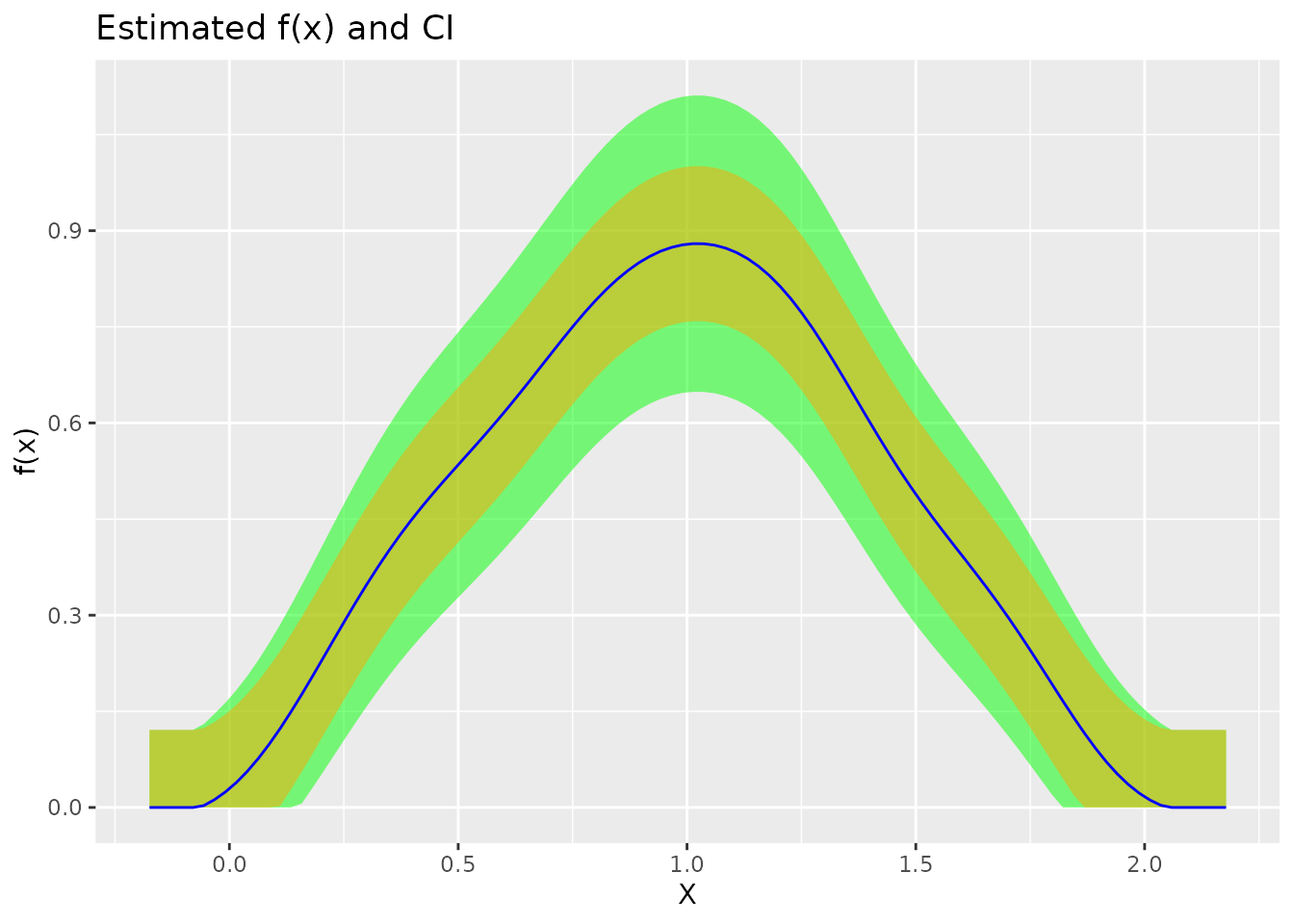
| Element | Description |
|---|---|
| Estimate | Kernel density estimate \(\hat{f}(x)\) |
| Bias bound | Bias range: \([\hat{f} - \bar{b}, \hat{f} + \bar{b}]\) |
| 95% CI | \([\hat{f} - \bar{b} - z\hat{\sigma}, \hat{f} + \bar{b} + z\hat{\sigma}]\) |
The type = "ft" plot shows how the smoothness parameters
are detected from the empirical Fourier transform:
plot(fit, type = "ft")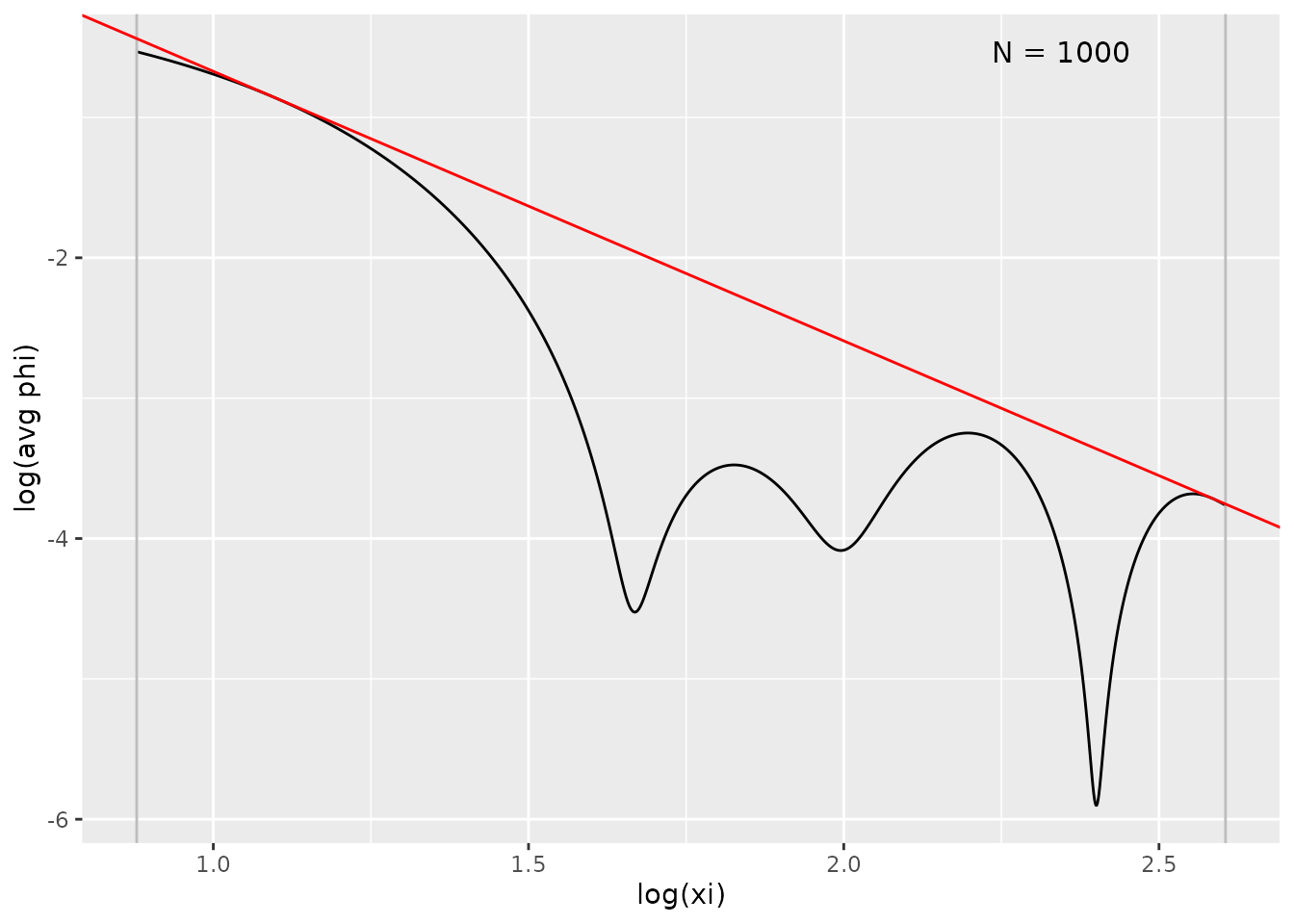
The legend labels each line:
- Empirical |phi|: the empirical Fourier transform \(|\hat{\phi}(\xi)|\)
- Fitted envelope: the estimated envelope \(A|\xi|^{-r}\), drawn over the selected window
- Shaded band: the selected frequency range \([\underline{\xi}, \bar{\xi}_n]\)
The slope \(r\) measures smoothness: a larger \(r\) means a smoother function.
Choosing the bandwidth
Set bw to a positive number for a fixed bandwidth, or to
"cv" or "silverman" for automatic selection.
Cross-validation is the default and minimizes the leave-one-out
least-squares density objective. The fast path uses linear binning and a
zero-padded FFT; it is checked against the direct objective in the
package tests:
fit_cv <- bias_bound_density(x_data, bw = "cv", kernel = "normal")
cat("CV bandwidth:", coef(fit_cv)["h"], "\n")
#> CV bandwidth: 0.1280561

plot(fit_cv) + ggtitle("Cross-Validation Bandwidth")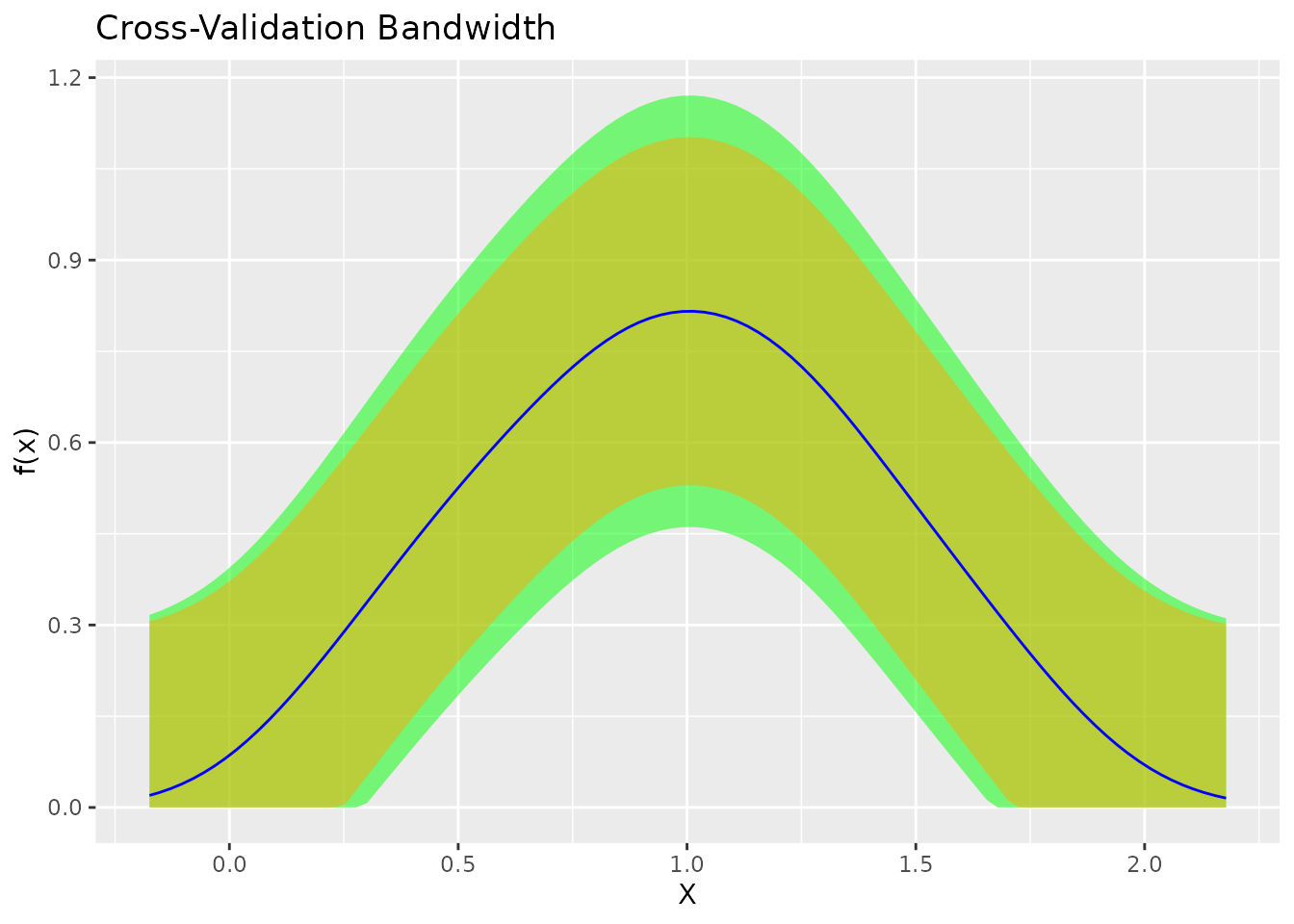
Silverman’s rule of thumb is a faster alternative. The normal-kernel
choice is the stats::bw.nrd0() rule; the package multiplies
it by 2.34 for Epanechnikov and uses a heuristic multiplier of 1.2 for
the two infinite-order kernels:
fit_silv <- bias_bound_density(
  x_data,
  bw = "silverman",
  kernel = "normal"
)
cat("Silverman bandwidth:", coef(fit_silv)["h"], "\n")
#> Silverman bandwidth: 0.09390781

plot(fit_silv) + ggtitle("Silverman's Rule Bandwidth")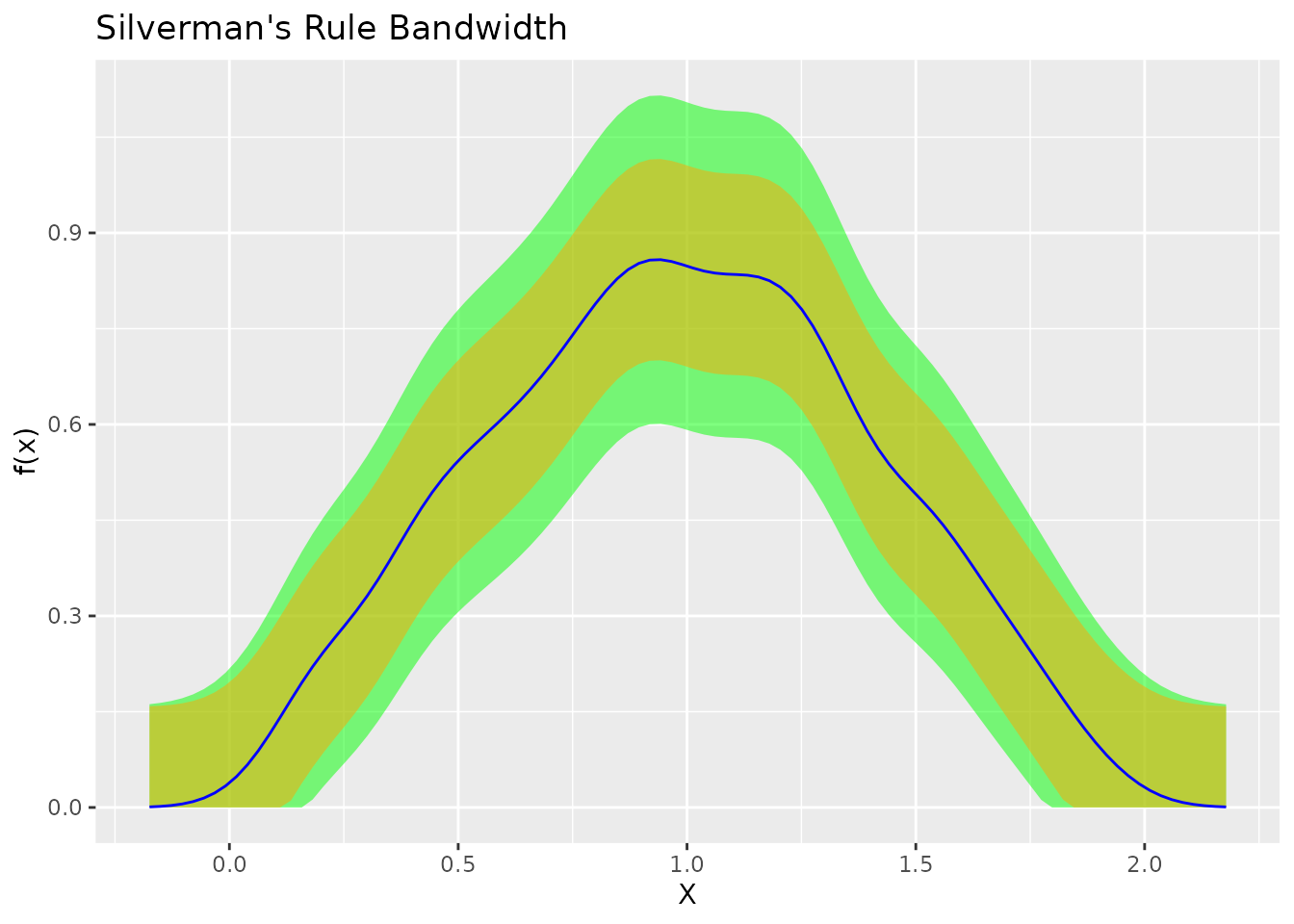
Kernel functions
Four kernels are available. The formal coverage theorem assumes an
infinite-order kernel whose Fourier transform equals one near the
origin, so "schennach" is the recommended
theorem-compatible default. The finite-order kernels are useful
comparisons, but a fit with them should not be described as covered by
the same theorem:
| Kernel | Order | Theory status |
|---|---|---|
| schennach | Infinite | Recommended theorem-compatible default |
| sinc | Infinite | Infinite-order comparison |
| normal | 2 | Finite-order comparison |
| epanechnikov | 2 | Finite-order comparison |
The same data fitted with each kernel:
fit_sch <- bias_bound_density(x_data, kernel = "schennach")
fit_sinc <- bias_bound_density(x_data, kernel = "sinc")
fit_norm <- bias_bound_density(x_data, kernel = "normal")
fit_epan <- bias_bound_density(x_data, kernel = "epanechnikov")

grid.arrange(
  plot(fit_sch) + ggtitle("Schennach2004 (infinite order)"),
  plot(fit_sinc) + ggtitle("Sinc (infinite order)"),
  plot(fit_norm) + ggtitle("Normal (2nd order)"),
  plot(fit_epan) + ggtitle("Epanechnikov (2nd order)"),
  ncol = 2
)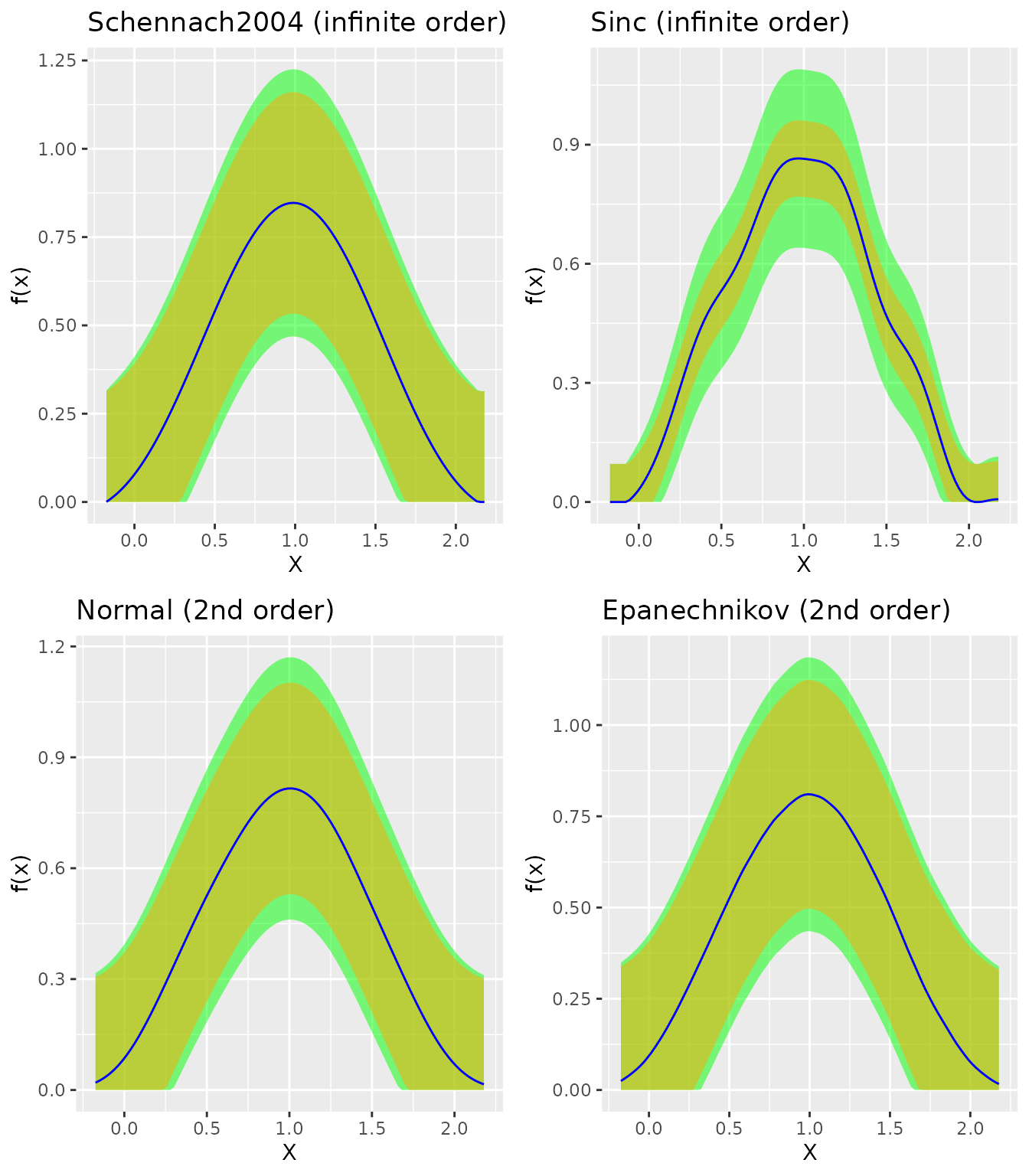
The default "schennach" kernel is the package’s
infinite-order kernel.
Bias and the bandwidth tradeoff
Changing the bandwidth moves the two pieces of the interval in opposite directions. A larger bandwidth lowers the variance (the sampling band narrows) but raises the bias (the bias band widens); a smaller bandwidth does the reverse. The plots below show the same data at the optimal bandwidth and at half of it:
fit_opt <- bias_bound_density(x_data, bw = "cv", kernel = "sinc")
h_opt <- unname(coef(fit_opt)["h"])

# Bias-bound interval at the optimal bandwidth
result_opt <- fit_opt

# ... and at a smaller (undersmoothed) bandwidth
result_under <- bias_bound_density(x_data, bw = h_opt * 0.5, kernel = "sinc")

grid.arrange(
  plot(result_opt) + ggtitle(paste0("Optimal bandwidth (h = ", round(h_opt, 3), ")")),
  plot(result_under) + ggtitle(paste0("Undersmoothed (h = ", round(h_opt/2, 3), ")")),
  ncol = 1
)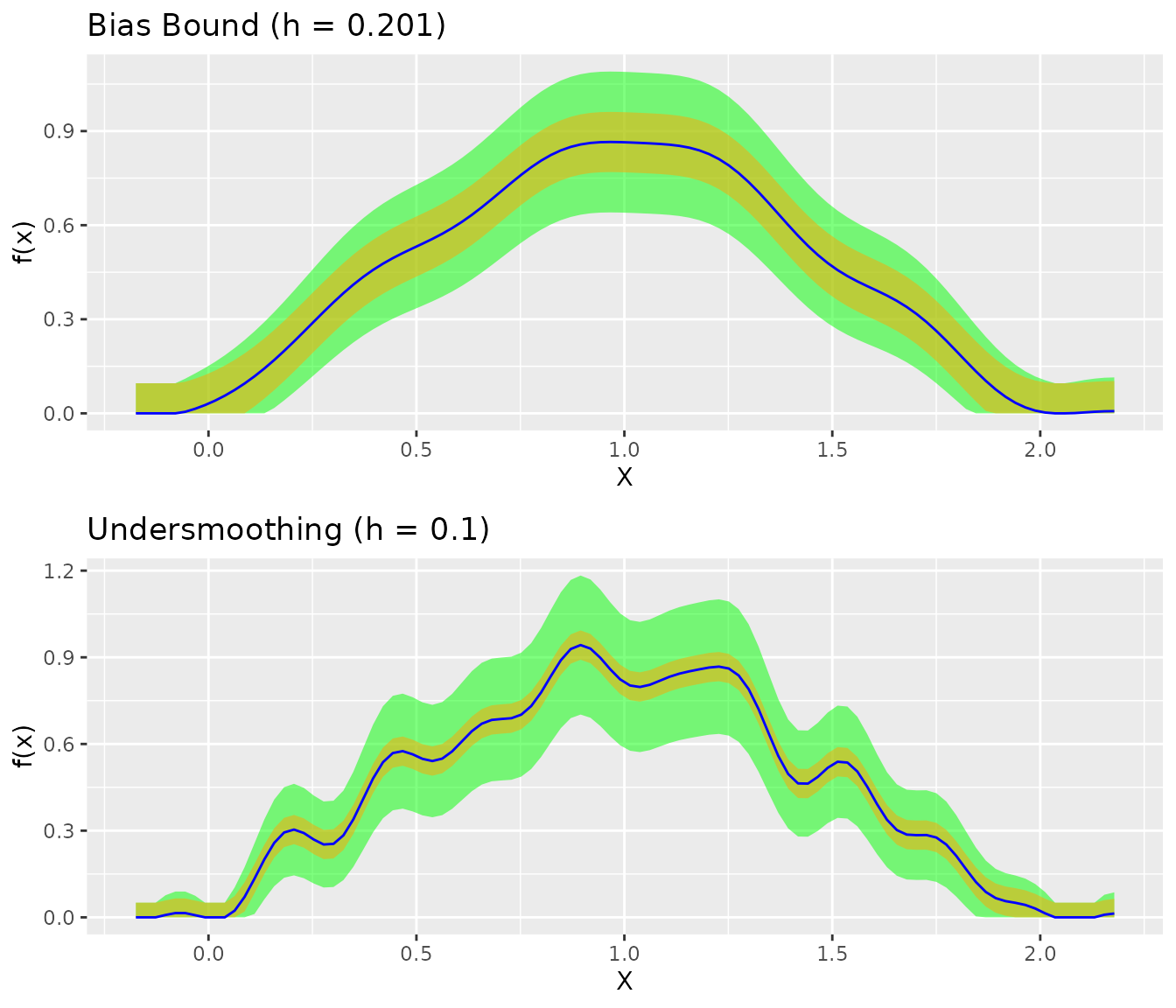
At the optimal bandwidth the bias band is the larger component, so the total interval here is wider than at the undersmoothed bandwidth. That is expected. Under the theorem’s smoothness, window, and kernel conditions, the bias allowance supports inference without shrinking the MSE-oriented bandwidth, and a single sample can still produce a wide band. The Theoretical Background article explains why a naive interval can under-cover when smoothing bias is non-negligible and why undersmoothing, the classical alternative, pays a variance cost.
More options
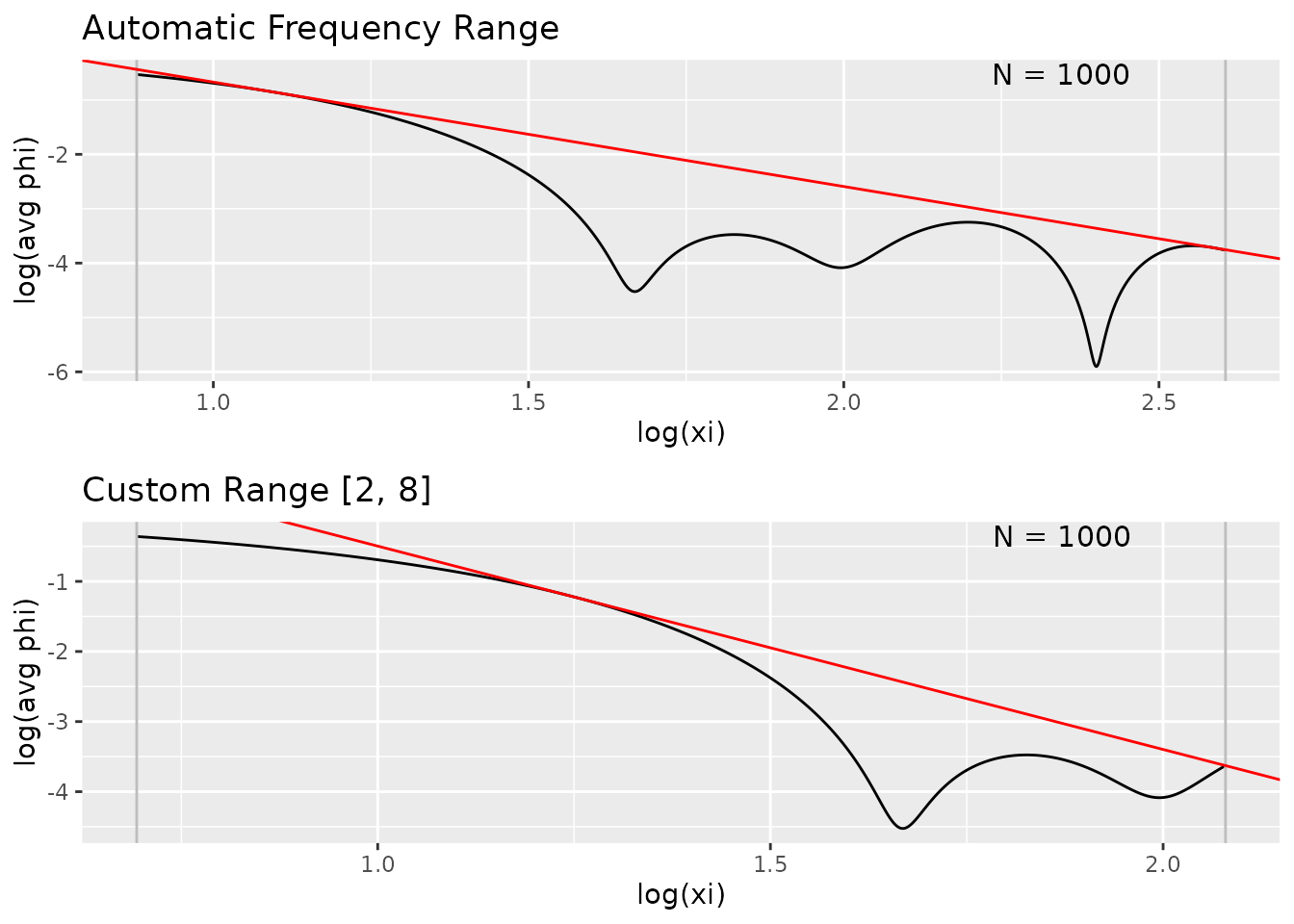
Advanced settings live in control. For example, set the
Fourier frequency window manually with frequency_range:
# Default (automatic)
fit_auto <- bias_bound_density(x_data, bw = 0.08)

# Custom range
fit_custom <- bias_bound_density(
  x_data,
  bw = 0.08,
  control = list(frequency_range = c(2, 8))
)

grid.arrange(
  plot(fit_auto, type = "ft") + ggtitle("Automatic Frequency Range"),
  plot(fit_custom, type = "ft") + ggtitle("Custom Range [2, 8]"),
  ncol = 1
)
The estimate, evaluation grid, and confidence intervals are all available on the fitted object:
# Confidence intervals as matrix
ci <- confint(fit)
head(ci, 10)
#>             lower      upper
#>  [1,] 0.000000000 0.01391246
#>  [2,] 0.000000000 0.01391246
#>  [3,] 0.000000000 0.01391246
#>  [4,] 0.000000000 0.01391246
#>  [5,] 0.000000000 0.01391246
#>  [6,] 0.000000000 0.02323744
#>  [7,] 0.000000000 0.03945872
#>  [8,] 0.000000000 0.05674960
#>  [9,] 0.001988962 0.07633667
#> [10,] 0.014643115 0.09834454

# Evaluation points
x_points <- fit$x
head(x_points)
#> [1] -0.1746134 -0.1508492 -0.1270850 -0.1033208 -0.0795566 -0.0557924

# Density estimates
f_hat <- fit$density
head(f_hat)
#> [1] 0.000000000 0.000000000 0.000000000 0.000000000 0.000000000 0.002945549
See Also
- Get Started: Quick introduction
- Regression: Conditional expectation estimation
- Theory: Mathematical background